





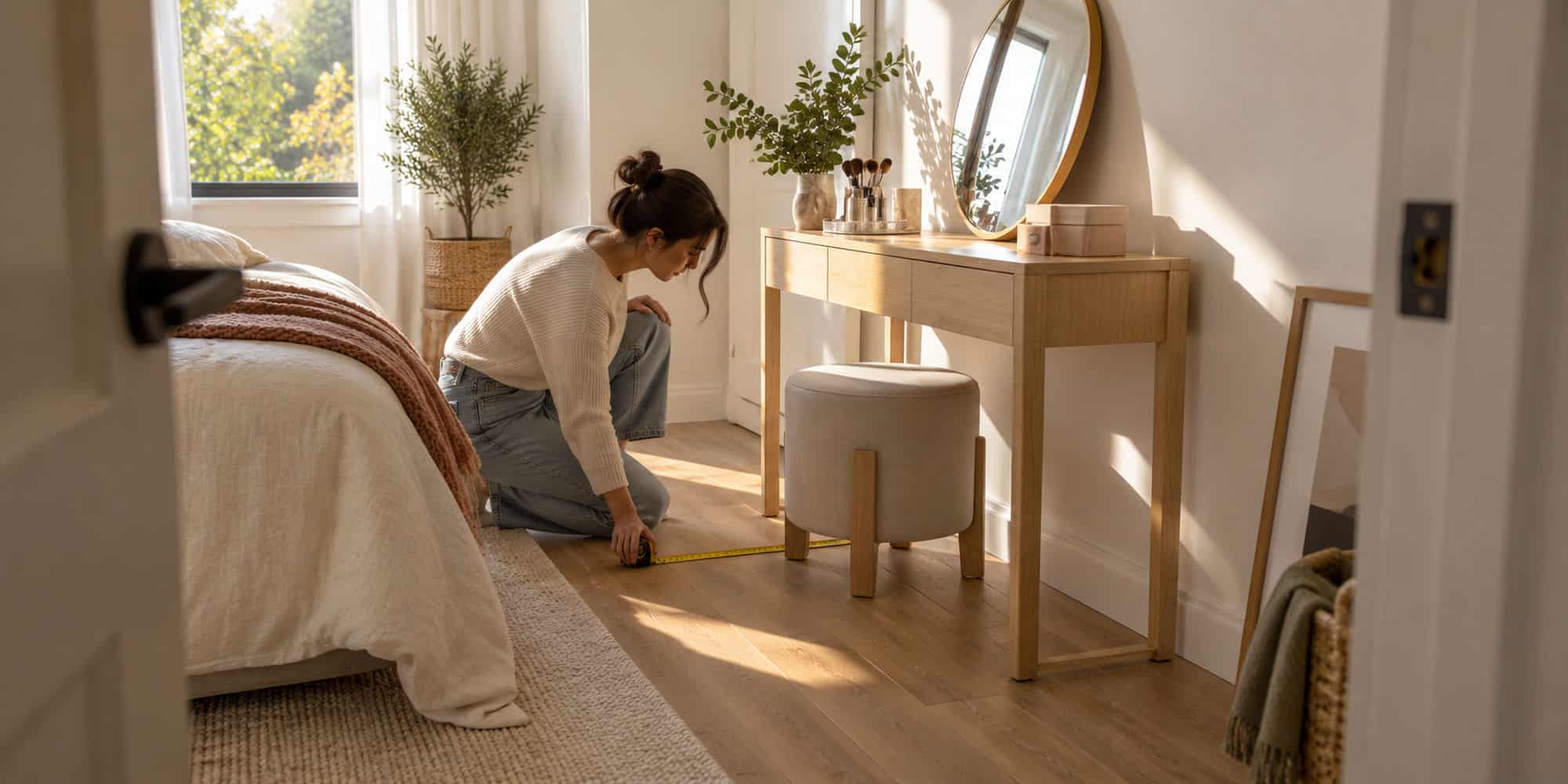
Why Dressing Table Dimensions Matter
A dressing table should make your daily routine easier, not turn a bedroom into an obstacle course. Before choosing a design, consider three measurements: the width along the wall, the depth into the room and the height of the tabletop. Then add the space needed for a stool, drawers and any mirror attached above it.
A compact table may save space but leave little room for skincare or jewellery. Measure the entire setup, not just the furniture footprint.
Dressing Table Dimensions at a Glance
There is no single standard dressing table size. Australian examples include compact units around 70–80 cm wide and wider designs around 100–120 cm; tabletop depth can be roughly 40–50 cm. Overall height depends on attached mirrors or shelves. These are examples, not guaranteed size ranges for every product.
For perspective, a compact dressing table can measure 70 cm wide, 42 cm deep and 77 cm high, while a wider, mirror-free design can measure 120 × 41 × 78 cm. A vanity set with an upright mirror can be much taller overall even if its table takes up less floor space. Always check which parts of a product are included in its listed measurements.
How Wide Should Your Dressing Table Be?
Width determines how much surface space you have and how comfortably the table fits against its chosen wall. In a smaller bedroom, a narrower design may be enough for a few daily essentials and a compact mirror. A wider surface allows more room for makeup, jewellery and hair tools.
Measure the free wall width between skirting boards, door frames and adjacent furniture. Do not assume the longest clear stretch of wall is entirely usable: drawers and wardrobe doors may need to open into that space. Check the table’s proportions beside your bed.
Depth, Legroom and Stool Clearance
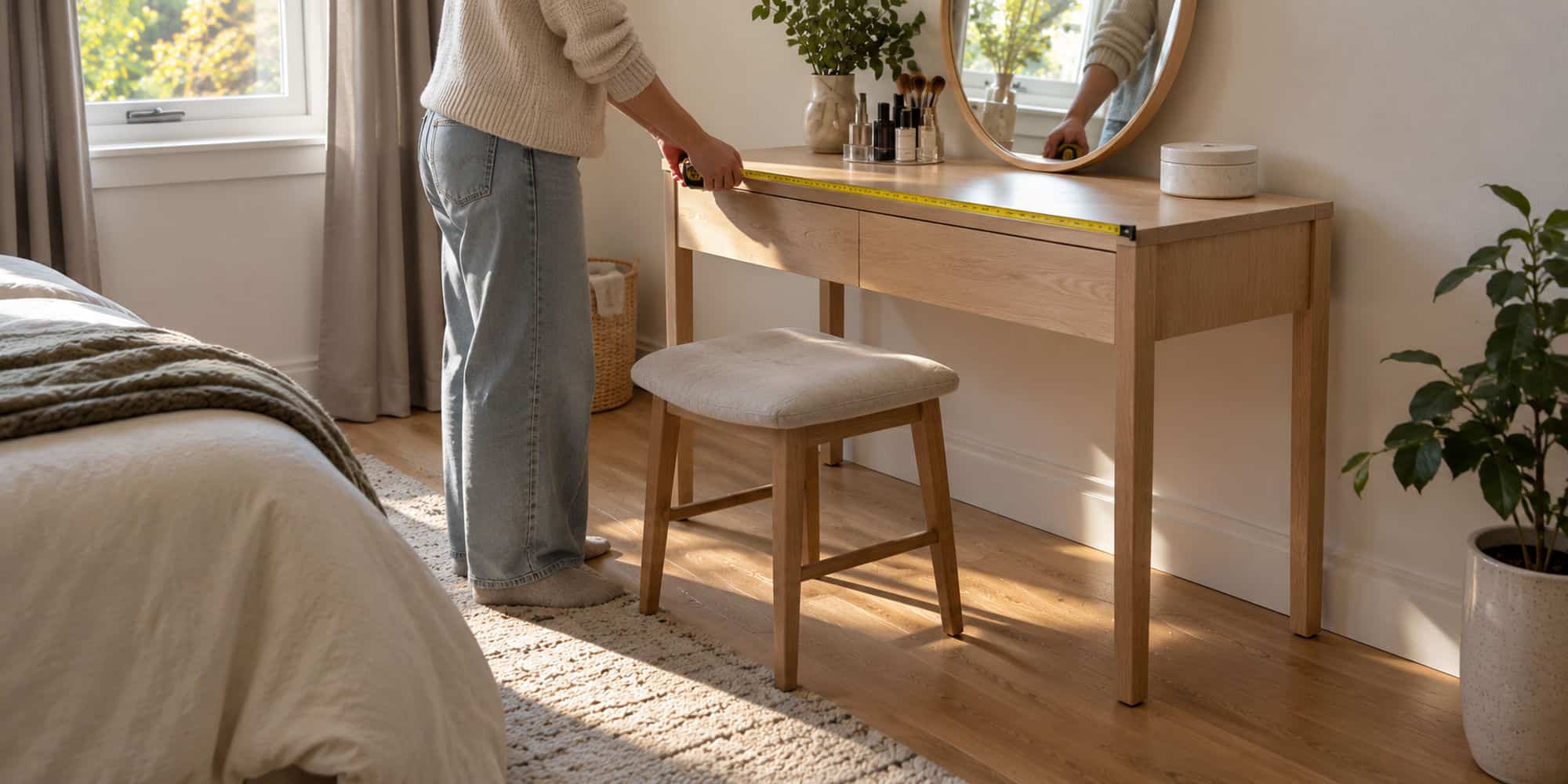
Depth is the distance the dressing table projects from the wall, and it is particularly important in a narrow room. A deeper top may give you more room for bottles and brushes, but it also leaves less floor space for movement. Check where the table legs and drawers sit underneath: external depth alone does not tell you how much knee and legroom you will have when seated.
Next, measure the stool. You need to be able to pull it out, sit down comfortably and reach any drawers without blocking a doorway or a main walkway. Try marking the tabletop footprint with painter’s tape on the floor, then place a chair or stool in front to test how the arrangement actually works. Leave room to move.
What Is a Comfortable Dressing Table Height?
Many conventional tabletop designs sit at roughly desk height, but a label such as ‘standard height’ does not guarantee comfort. Comfort depends on the stool height, drawer position and your proportions. For a practical fit, you should be able to sit with your feet supported and your knees clear of the underside.
When comparing products, look for the actual tabletop height rather than relying on the largest height shown in the specifications. With a tall mirror, the figure may describe the complete unit. If tabletop height is not stated, check the product diagram.
Remember the Mirror and Lighting
A built-in mirror changes the height you need to allow against the wall. For example, our vanity set with an LED mirror and stool lists overall dressing table dimensions of 80 cm wide, 40 cm deep and 127 cm high, along with separate stool dimensions. That 127 cm measurement describes a vanity setup with an upright mirror, not a conventional desk-height tabletop.
Check that the mirror can be used comfortably from your chosen seat and that it will not clash with a window sill, wall shelf or sloping ceiling. For lighted mirrors, also check power-point access and the specific model’s electrical requirements.
Making a Dressing Table Work in a Small Bedroom
A compact bedroom does not automatically rule out a dressing table. A slimmer surface, thoughtful placement and a stool that tucks underneath can make the area feel more manageable. Positioning the table near existing light can also help, provided it does not interfere with blinds, windows or walkways. If storage is important, consider whether shallow drawers meet your needs without making the table feel bulky.
Choose enough usable room for your actual routine, not simply the largest mirror or most drawers. Browse our dressing tables to compare complete vanity sets, then check the dimensions of the individual design before deciding what will fit your room.
Quick Measuring Checklist Before You Buy
Before ordering, use this short checklist to test the whole setup rather than the tabletop alone:
• Measure the free wall width, available floor depth and any nearby door or wardrobe swing.
• Check the tabletop height separately from the full height of a mirror or shelves.
• Allow enough room to pull out the stool, move your knees and open drawers.
• Check the positions of power points, windows and other wall fittings if the design includes a lighted mirror.
• Confirm whether the stated dimensions refer to the assembled furniture, individual parts or the delivery packaging.
Final Thoughts
The right dressing table dimensions are the ones that suit both your room and the way you get ready. Think beyond width: depth, comfortable seating, mirror height and clearance around the furniture all matter. A few minutes spent measuring now can make the finished bedroom much easier to use every day.
FAQ
What is the standard height of a dressing table?
There is no universal height, although some tabletop-style dressing tables are around 77–78 cm high. A model with an attached mirror can be substantially taller overall. Compare the tabletop height with your stool, not just the tallest point on the unit.
How much space should I leave in front of a dressing table?
Leave enough room to pull a stool away from the table, sit comfortably, access drawers and pass through the room. The amount depends on your stool, nearby furniture and traffic flow, so test the arrangement using actual dimensions rather than one fixed clearance figure.
Are narrow dressing tables practical?
They can be, especially when you only need room for a mirror and a few frequently used items. Check the usable surface and legroom as carefully as the overall width, and decide whether you need drawers or separate storage nearby.
Does dressing table height include the mirror?
Sometimes. Product listings may show the overall height of the assembled vanity, including the mirror, while others list only the tabletop. Read the dimension labels carefully and look for a separate table-height measurement when planning your stool.