






A sofa bed is one of the most practical purchases you can make for a home that occasionally hosts overnight guests – but it’s also one of the easiest to get wrong. The challenge is that you’re essentially buying two pieces of furniture in one, and the compromises required to make something work as both a sofa and a bed mean that not all sofa beds do either job particularly well. Knowing what to look for before you buy makes a significant difference to how satisfied you’ll be with the result.
A Sofa Bed Is Two Purchases in One
The most useful way to think about a sofa bed is to evaluate it as a sofa first and a bed second – because you’ll be using it as a sofa the vast majority of the time.
A sofa bed that looks great unfolded but feels awkward and uncomfortable as a sofa is a poor daily living choice, regardless of how good the mattress is. Conversely, a sofa bed that’s comfortable to sit on but has a thin, unsupportive mattress will leave guests sleeping poorly and unlikely to visit again.
The goal is to find a model that performs genuinely well in both configurations – which is achievable, but requires paying attention to the right details rather than just the overall look.
The Main Types of Sofa Bed Mechanisms
Understanding how a sofa bed converts is important because the mechanism affects both ease of use and long-term durability.
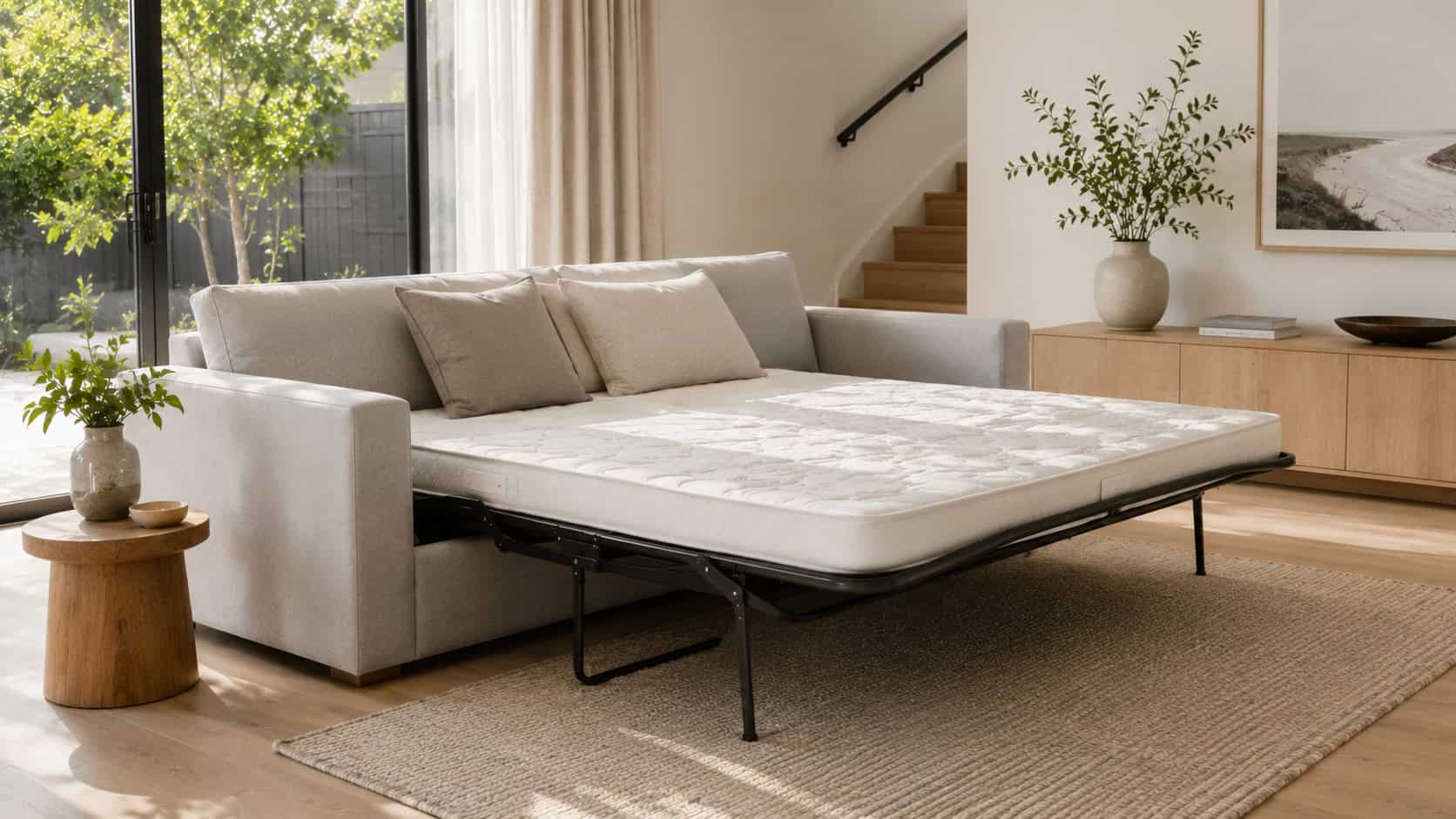
Fold-out or pull-out sofa beds are the most common type. A metal frame and mattress are stored beneath the seat cushions and unfold outward when needed. These tend to offer the most mattress space – usually a double or queen size when open – and the mechanism is straightforward once you know how it works. The trade-off is that they require clear floor space in front of the sofa to unfold into, so they work best in rooms where the furniture can be moved temporarily.
Click-clack sofa beds convert by reclining the backrest to a flat position, turning the sofa seat and back into a sleeping surface. They’re simpler to operate and more compact when open, but the sleeping surface is limited to the sofa’s existing dimensions – which means they’re usually more comfortable for a single sleeper or child than for two adults.
Futon-style sofa beds fold forward so the backrest becomes an extension of the seat, creating a flat sleeping surface. They’re typically the most affordable option and the simplest mechanism, but the mattress thickness is usually quite modest.
For most households hosting adult guests, a fold-out sofa bed with a proper mattress is the most practical choice.
Mattress Quality – The Detail Most People Overlook
Mattress quality is where many sofa beds fall short, and it’s the detail that has the biggest impact on how comfortable a guest will actually be.
Standard fold-out sofa beds often come with a thin foam mattress – typically 8-10cm thick. This is noticeably thinner than a standard bed mattress and can feel firm and unforgiving, particularly for guests sleeping more than one night. The metal bar where the frame folds can also be felt through a thin mattress, which is one of the most common complaints about sofa beds.
What to look for:
- Mattress thickness: Aim for at least 10-12cm of mattress depth. Thicker is better, though very thick mattresses can make the sofa feel bulkier when closed.
- Foam density: Higher density foam is more supportive and durable. Low-density foam compresses quickly and loses its shape.
- Pocket spring options: Some higher-quality sofa beds include a pocket spring mattress rather than foam, which provides significantly better support and is worth considering if the sofa bed will be used frequently.
If you’re buying a sofa bed primarily for occasional use – a few nights a year – a standard foam mattress will probably suffice. If guests stay regularly, investing in a model with a better quality mattress from the outset is worthwhile.
Size – What Fits as a Sofa and What Works as a Bed
Sofa bed sizing requires thinking about both configurations at once.
As a sofa, the width determines how many people can sit comfortably day to day. A 2-seater sofa bed is compact and practical for smaller rooms; a 3-seater gives more daily seating but takes up more floor space and requires more room to unfold.
As a bed, the open dimensions are what matter for sleeping comfort. A fold-out sofa bed typically opens to a double (around 138cm wide) or queen size (around 153cm wide). For two adults sleeping together, queen is noticeably more comfortable. For a single guest or child, double is sufficient.
Also consider the room the sofa bed will live in. When fully open, a fold-out sofa bed extends significantly in front of the sofa – usually 180-200cm. Measure the available floor space in front of the sofa position to make sure there’s room to open it fully without rearranging the whole room every time.
Our guide on how to choose the right sofa size covers room measurement and clearance in detail – the same principles apply when sizing a sofa bed.
Fabric and Frame Considerations
The fabric on a sofa bed needs to be durable enough to handle both daily sofa use and the repeated folding and unfolding of the conversion mechanism. This puts more stress on the upholstery than a standard sofa, particularly at the fold points.
Look for tightly woven fabrics that resist pilling and are easy to spot clean. Performance fabrics with some stretch are better at the fold points than rigid upholstery that can crease or crack over time. Velvet and boucle look beautiful on standard sofas but are generally less practical on sofa beds where the upholstery is under more mechanical stress.
The frame material matters for longevity. A hardwood or solid timber frame is more durable than a particleboard construction and will handle the repeated mechanism use better over time. Ask about frame construction if it’s not specified in the product details.
Browse our sofa beds to compare available sizes, mechanisms and upholstery options.
Where to Put a Sofa Bed in Your Home
Sofa beds work best in specific situations, and it’s worth being clear about where yours will live before you buy.
Guest bedroom or study: A sofa bed in a dedicated guest room or home office is the ideal use case. It functions as a sofa or day seat most of the time and converts easily when guests arrive. In this setting, the room is specifically set up to accommodate the open bed configuration.
Living room: A sofa bed in the main living room works well in apartments or homes without a dedicated guest room. The main consideration is whether the living room layout can accommodate the open bed without requiring significant furniture rearrangement each time.
Studio apartments: In a studio or open-plan apartment where the living space doubles as the sleeping space, a sofa bed is often the most practical solution. In this context, it’s worth investing in a model with a better quality mattress since it will likely be used more frequently.
One thing to avoid is placing a sofa bed in a position where the mechanism can’t open fully – against a wall it would open into, or in front of a coffee table that’s too heavy to move easily.
Final Thoughts
A well-chosen sofa bed is a genuinely useful piece of furniture that earns its place in homes that host guests without a dedicated spare room. The key is to evaluate the sofa and the bed separately – check that it’s comfortable to sit on daily, that the mattress is thick enough for a decent night’s sleep, and that the mechanism operates smoothly and fits your room when open. Get those three things right and a sofa bed becomes one of the most practical purchases in the home.