






Bedroom storage is one of those things that’s easy to underestimate until you don’t have enough of it. Whether you’re furnishing a new bedroom from scratch or trying to get a better handle on an existing space, the choice between a chest of drawers and a wardrobe comes up sooner or later. They serve different purposes, and in many bedrooms the answer isn’t one or the other – it’s both. Here’s how to think through what you actually need.
What Is a Chest of Drawers Best For?
A chest of drawers excels at storing folded items – anything that doesn’t need to be hung. Think everyday basics like t-shirts, shorts, underwear, socks, gym wear, sleepwear and jumpers. These are the items that make up the bulk of most people’s daily wardrobe rotation, and drawers are arguably the most efficient way to store them.
Beyond clothing, a chest of drawers is also useful for storing items you want close at hand in the bedroom without leaving them out on surfaces. Extra bed linen, accessories, jewellery trays and similar items all work well in drawers.
From a design perspective, a chest of drawers is a relatively compact piece of furniture that can do a lot of storage work without taking up significant floor space. A standard 5 or 6-drawer chest typically offers substantial capacity in a footprint of around 80-100cm wide and 45-50cm deep – making it a practical choice even in smaller bedrooms.
What Is a Wardrobe Best For?
A wardrobe’s main advantage is hanging space – and that’s what sets it apart from a chest of drawers. Anything that creases easily or loses its shape when folded belongs on a hanger: shirts, blouses, dresses, blazers, trousers and suits.
Most built-in or freestanding wardrobes also include a combination of hanging rail, shelves and sometimes drawers, which means they can handle a mix of folded and hung items. This makes a wardrobe a more versatile all-in-one solution, particularly if you have a large clothing collection or limited space for multiple pieces of furniture.
The trade-off is footprint. A freestanding wardrobe takes up considerably more floor space than a chest of drawers, and in a smaller bedroom it can feel like it dominates the room. Built-in wardrobes solve the space problem but aren’t always an option in rental properties or older homes.
Can You Use Both?
In most bedrooms, yes – and this is often the best outcome. A wardrobe handles hung items and larger folded pieces like jeans and knitwear, while a chest of drawers takes care of the smaller folded everyday items that would otherwise take up valuable shelf space inside the wardrobe.
Using both also means your wardrobe stays less cluttered. When everything has a logical home, it’s easier to keep the bedroom tidy without having to reorganise constantly.
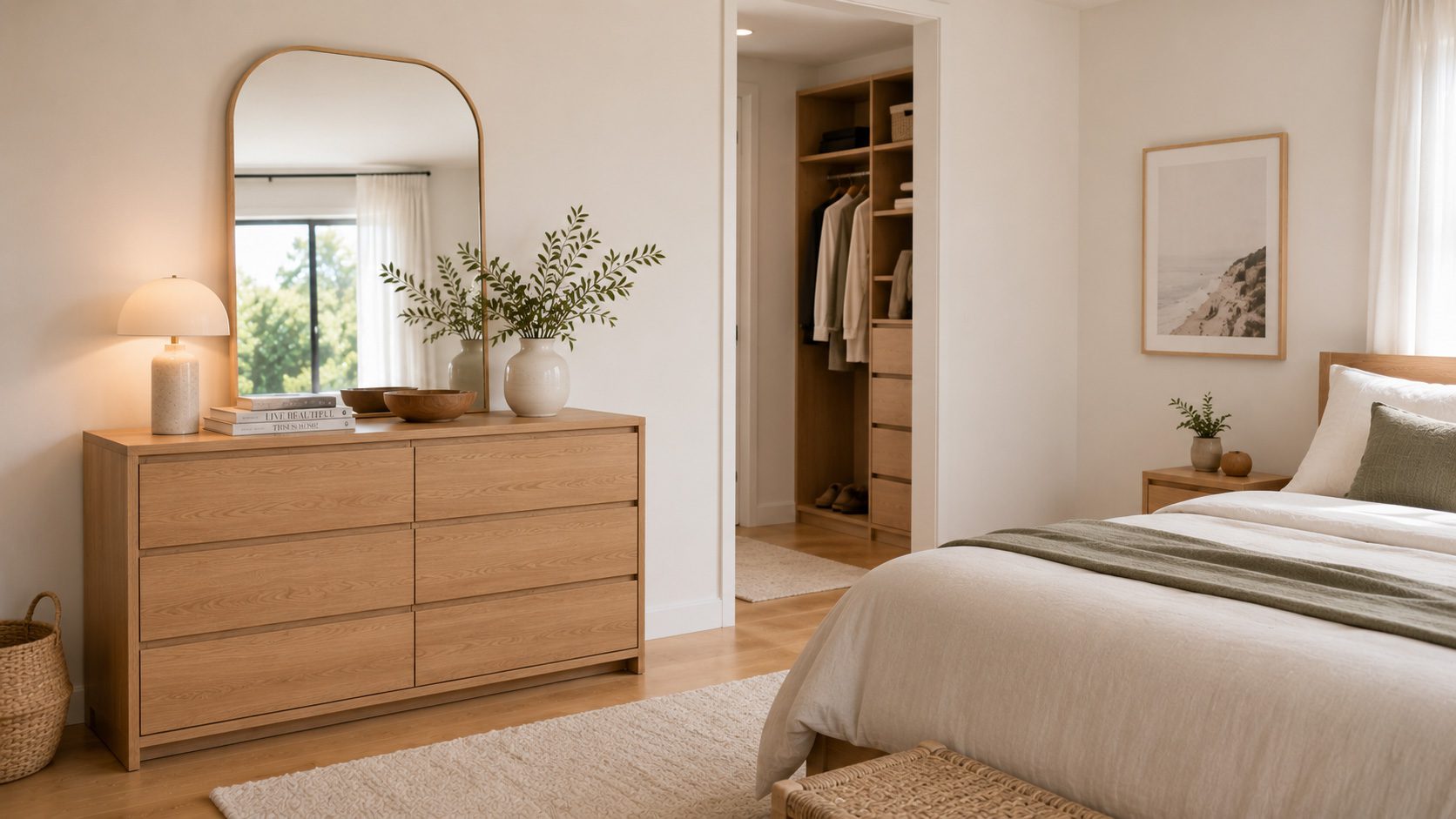
The combination works particularly well in a master bedroom where two people are sharing storage, or in any bedroom where the clothing volume is high enough that a wardrobe alone doesn’t provide enough organised space. A chest of drawers placed beside or opposite the wardrobe can double as a surface for a mirror, lamp or small décor items – giving it a dual function in the room.
How Much Storage Do You Actually Need?
A realistic audit of what you own is the most useful starting point.
Count how many items in your wardrobe need to be hung versus folded. If the majority of your clothing is hung – formal wear, shirts, dresses – a wardrobe is your priority and a chest of drawers is a useful supplement. If most of your wardrobe is casual and folded – activewear, basics, knitwear – a chest of drawers may actually cover the bulk of your needs and the wardrobe becomes the supplement.
Also think about seasonal rotation. If you store off-season clothing in the bedroom rather than elsewhere in the house, factor in that extra volume when deciding how much storage you need. A bedroom that’s short on storage tends to feel chaotic regardless of how well it’s styled.
Browse our chest of drawers to find sizes that suit your storage needs and bedroom layout.
Space and Room Layout Considerations
Storage decisions should always be made in the context of your actual room dimensions – not just what would be ideal in theory.
In a smaller bedroom: A chest of drawers is usually the more space-efficient choice. It stores a surprising amount in a compact footprint and doesn’t visually overwhelm the room the way a large wardrobe can. If hanging space is essential, a slim freestanding wardrobe or a built-in solution along one wall will make better use of the available space than a bulky freestanding design.
In a medium to large bedroom: You have the flexibility to use both comfortably. Think about the layout carefully – wardrobes typically work best against a full wall, while a chest of drawers can sit in a corner, beside the bed or at the foot of the bed depending on the room’s configuration.
In a shared bedroom: Storage needs are doubled, and organisation becomes even more important. Two chests of drawers – one per person – is a practical solution that keeps each person’s items separate without requiring an oversized wardrobe. Pairing this with a shared wardrobe for hung items covers most storage needs without the bedroom feeling cluttered.
Always leave enough clearance in front of drawers and wardrobe doors to open them fully – at least 60-70cm in front of a chest of drawers and around 60cm in front of a wardrobe door. Factor this into your room layout before you buy.
Final Thoughts
The chest of drawers vs wardrobe question is really a question about what you own and how you store it. Start by auditing your clothing, decide what needs to be hung and what can be folded, and let that drive the decision. For most people, a combination of both gives the best outcome – a wardrobe for hung items and a chest of drawers for the everyday folded basics that make up the majority of your daily routine. Get the storage right and the rest of the bedroom falls into place much more easily.