





An outdoor dining set that’s too large for the space leaves no room to move around it. One that’s too small looks lost on a large patio and fails to seat everyone comfortably when it matters. Getting the size right outdoors requires a slightly different approach to indoor dining – the space behaves differently, the usage patterns are different, and there are a few additional factors that don’t apply inside the home. Here’s how to work through the decision.
Outdoor Dining Is Different from Indoor
The principles of measuring and sizing overlap with indoor dining, but outdoor spaces come with their own set of considerations.
Outdoor areas are often less defined than indoor rooms – a patio, deck or alfresco area doesn’t always have four walls to measure between. Wind, sun direction, shade structures and access points all affect where the table can practically sit and how much space is actually usable. The ground surface matters too – chairs on uneven pavers or grass can be harder to move than chairs on a smooth indoor floor, which means you may need slightly more generous clearance.
Outdoor dining also tends to be more social and flexible by nature. Most households use their outdoor dining set for everything from everyday family meals to larger gatherings, which means thinking about occasional peak capacity – not just everyday use – is more important outdoors than it is inside.
Measure Your Outdoor Space First
Start with the dimensions of the area where the table will sit. For a covered alfresco or deck, measure between the structural elements – posts, walls and balustrades. For an open patio, decide on a zone for the dining area and measure that space specifically.
As with indoor dining, allow a minimum of 90cm clearance on all sides of the table for comfortable movement. On a patio that’s used regularly for entertaining, 100-110cm is a more comfortable target – it gives guests room to pull out a chair and stand without bumping into someone behind them.
Once you’ve subtracted the clearance from your available space, you’ll have a maximum table footprint to work with. This number often makes the size decision for you.
Also consider what else shares the space. If there’s a built-in BBQ, a garden bed border, or a pool fence nearby, factor these into the clearance calculation. A dining set that technically fits but leaves only 60cm between the chairs and the pool fence will feel uncomfortable to use in practice.
How Many People Do You Actually Need to Seat?
Be honest about two numbers: your everyday household size and your typical entertaining capacity.
For everyday use, most households are 2-4 people. A 6-seater table covers this comfortably while leaving room for one or two extra guests without feeling crowded. For households of 5 or 6, an 8-seater is a practical step up.
For entertaining, think about how often you host and how many people typically attend. If you regularly have 8-10 people around for a Sunday lunch, a 6-seater table will always feel like it’s not quite enough. If you host large gatherings a few times a year, an extendable table or a 10-seater might be worth considering.
Dreamo Living offers outdoor dining sets across a range of sizes – from 6-seater outdoor dining sets through to 10-seater outdoor dining sets – so it’s worth narrowing down your size requirement before browsing.
Fixed vs Extendable – Which Makes More Sense Outdoors?
Extendable dining tables are a popular choice indoors for good reason – they give you flexibility without the everyday footprint of a large table. Outdoors, the calculus is slightly different.
Outdoor extension mechanisms are exposed to the elements and can be more prone to stiffness or corrosion over time compared to indoor equivalents. If you choose an extendable outdoor table, look for one with a well-sealed mechanism and a reputation for smooth operation after extended outdoor use.
For most households, a fixed outdoor dining table in a size that covers both everyday use and typical entertaining is the more practical choice. It’s simpler, more robust, and doesn’t require managing an extension mechanism that may need maintenance over time.
If your entertaining numbers vary widely – say, 4 people most of the time and 12 on occasion – a large fixed table with a few extra foldable chairs stored nearby is often a more reliable solution than an extendable table pushed to its maximum.
Table Shape and Your Outdoor Layout
Shape affects both how many people you can seat and how the table fits into the outdoor space.
Rectangular tables are the most common choice outdoors and work well on most patio and deck layouts. They seat efficiently along the long sides and suit a defined, structured outdoor dining area.
Round tables work well for smaller groups and in more intimate outdoor settings – a courtyard, a balcony or a sheltered corner. They encourage conversation and allow everyone to face each other easily. The trade-off is that they don’t scale up as efficiently as a rectangular table when numbers increase.
Square tables suit square outdoor spaces and smaller groups of four. They look clean and balanced in the right setting but can feel limiting if you regularly need to seat more than four people.
For a more detailed breakdown of how table shape affects seating and room layout, our guide on round vs rectangular dining tables covers the key differences – most of the same principles apply outdoors.
Don’t Forget Clearance and Access
A few specific clearance considerations for outdoor dining that don’t always apply indoors:
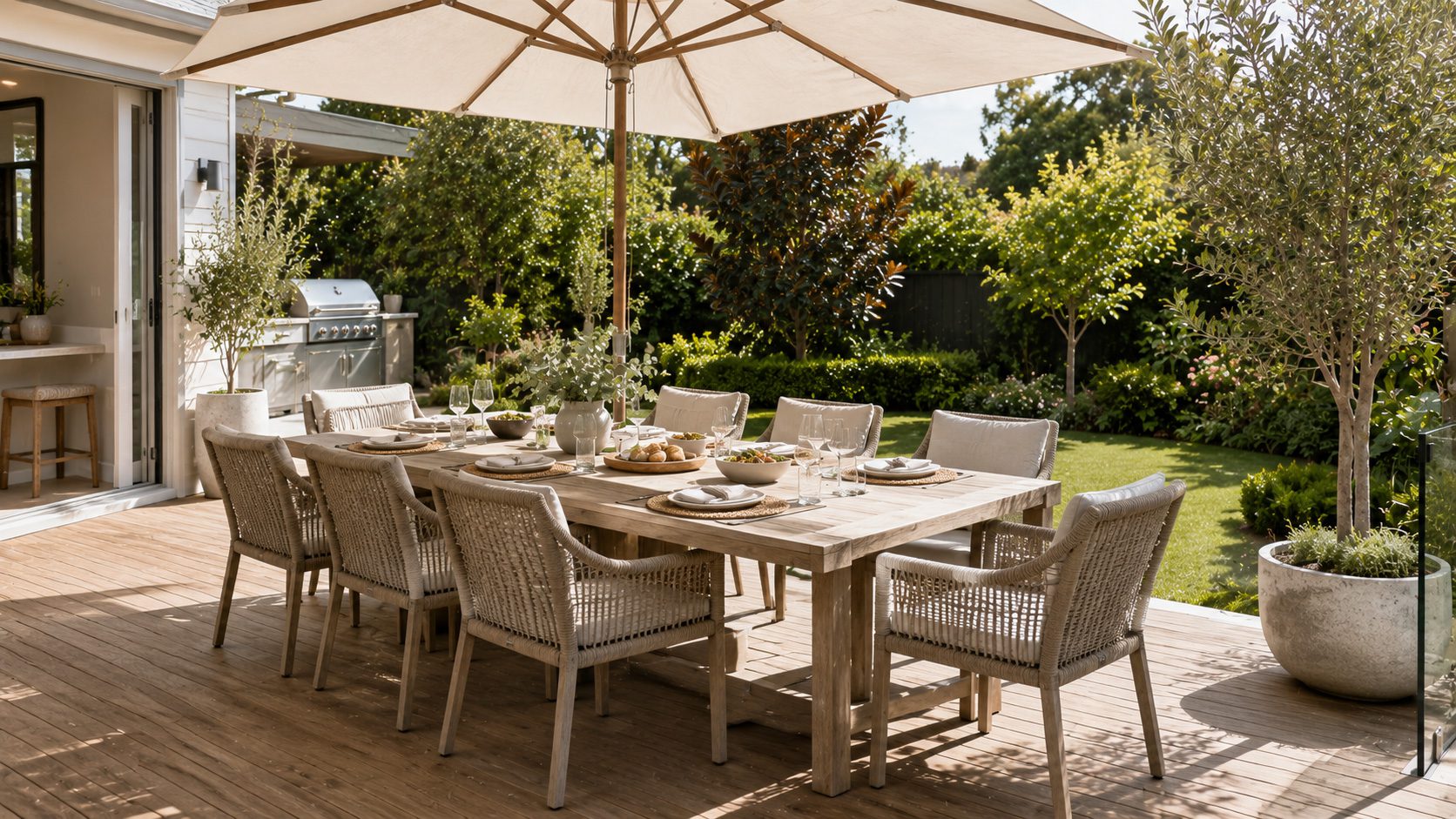
Shade structures: If you’re using an umbrella or shade sail over the dining table, the umbrella base or shade sail posts will take up floor space and may affect chair placement. Measure the umbrella base footprint and factor it into your layout before buying the table. A table with a central umbrella hole gives you more flexibility here. Browse our outdoor umbrellas to check base dimensions if this applies to your setup.
Door and sliding door clearance: If the outdoor dining area is accessed via a sliding door or bifold, make sure chairs pulled out from the table don’t block the door from opening fully. This is a surprisingly common oversight that’s easy to avoid with a quick measurement.
Steps and level changes: If your patio has a step up or down, make sure there’s enough flat space around the table for chairs to be moved comfortably without catching on the edge.
For more detail on measuring for a dining table and calculating per-person space requirements, our indoor dining table size guide covers the fundamentals in depth.
Final Thoughts
Choosing the right size outdoor dining set comes down to measuring your space carefully, being realistic about how many people you regularly need to seat, and leaving enough clearance for comfortable movement on all sides. Outdoor spaces have their own quirks – shade structures, uneven surfaces, access points – so it pays to think through the full picture before committing to a size. Get the dimensions right and you’ll have an outdoor dining setup that works as well for a quiet weeknight dinner as it does for a full table of guests on a Sunday afternoon.