





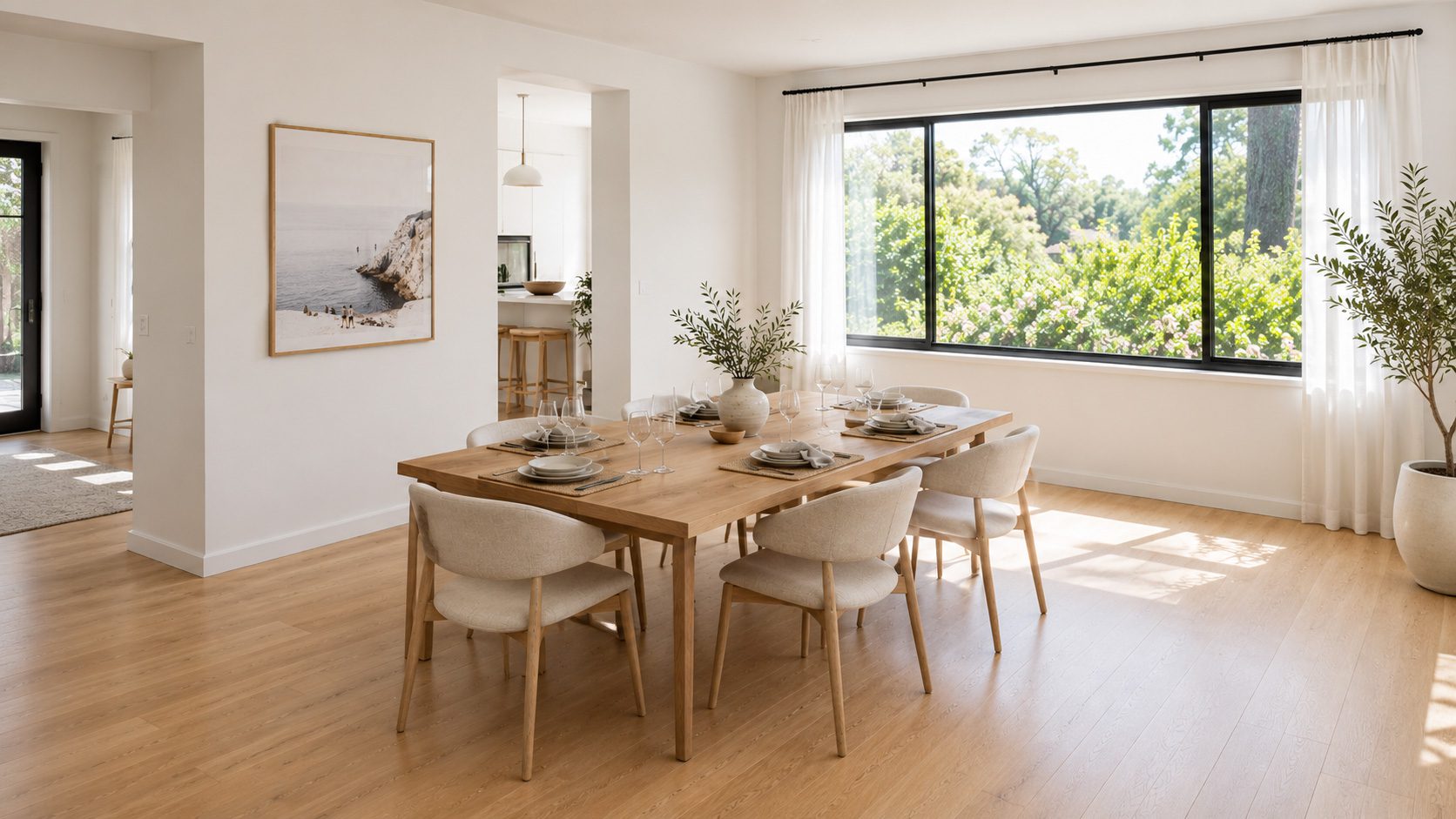
Picking the wrong dining table size is one of the most common furniture mistakes people make – and it’s usually not discovered until the table is already in the room. Either it’s too large and everyone has to shuffle sideways to get to their seat, or it’s too small and feels lost in the space. Getting the size right from the start saves a lot of hassle, and it’s easier than you might think with a few simple measurements and guidelines.
Start with Your Room Dimensions
Before you look at a single table, measure your dining area. You need two numbers: the length and width of the space where the table will sit.
From those measurements, subtract at least 90cm on each side to allow for chair clearance and comfortable movement around the table. What you’re left with is your maximum table size.
For example, if your dining area is 4 metres long and 3.5 metres wide, your maximum table size would be roughly 2.2m x 1.7m – leaving 90cm of clearance on all sides. In practice, most people go slightly smaller than the maximum to give the room a bit more breathing space.
If your dining area is part of an open-plan living space, measure specifically the zone you intend the table to occupy rather than the entire room. It helps to use masking tape on the floor to mark out the table footprint before you buy – it’s a simple trick that gives you a much clearer sense of how the size will feel in person.
Standard Dining Table Sizes Explained
Dining tables come in a wide range of sizes, but most fall into a few common categories based on how many people they seat.
2-seater tables: Typically around 75-90cm in diameter for round tables, or 75-90cm wide and 75cm deep for rectangular. These are compact by design and best suited to small apartments or breakfast nooks rather than main dining areas.
4-seater tables: Usually 90-120cm for round tables, or around 120cm long for rectangular. A 120cm rectangular table seats four people comfortably, though it can feel tight if the chairs are large.
6-seater tables: Round tables in this range are typically 135-150cm in diameter. Rectangular tables are usually 150-180cm long. This is the most popular size for family homes.
8-seater tables: Rectangular tables from around 200-220cm long. At this size, table width becomes important too – 90-100cm wide allows enough room for place settings on both sides without feeling crowded across the middle.
10 to 12-seater tables: From 240cm and upwards. These are large-scale pieces that need a genuinely spacious room to work well.
If you’re unsure which size suits your household, our dining sets include matched table and chair combinations across the most common size ranges, which makes it easier to visualise the full setup.
How Much Space Do You Need Per Person?
A comfortable place setting requires around 60cm of table width per person. This gives enough room for a plate, cutlery and a glass without elbows clashing.
Use this as a quick check: take the total length of your table and divide it by 60cm to get the number of people who can sit comfortably along each side. Then factor in the ends if you’re using a rectangular table.
For example, a 180cm rectangular table divided by 60cm gives you three seats per side – so six people seated along the length, plus one at each end if needed, giving a total of eight. In practice, most people use a 180cm table for six to keep it comfortable.
For round tables, the same 60cm per person rule applies around the circumference. A 120cm round table has a circumference of roughly 375cm, which divides into about six 60cm spaces – though in reality a 120cm round table seats four to five people most comfortably.
Don’t Forget Chair Clearance
Table size and chair clearance are two separate things, and both matter.
When a chair is pulled out and someone is seated, it extends roughly 50-60cm behind the table edge. You need that space to be clear – not blocked by a wall, another piece of furniture or a high-traffic walkway.
The 90cm clearance rule mentioned earlier accounts for this. But if your chairs are larger than average, or if you have a bench seat on one side, measure the actual depth of the chair when occupied rather than just the chair frame itself.
Also consider chair height in relation to table height. Standard dining tables are around 75-76cm high, and standard dining chairs have a seat height of around 45cm – leaving roughly 30cm of clearance between the seat and the underside of the table. If you’re mixing a table and chairs from different ranges, always check these measurements align before you buy.
Our dining chairs are worth browsing alongside the tables to make sure proportions work together.
What If Your Space Is Tight?
Smaller dining areas don’t have to mean compromising on functionality – it just requires a bit more thought.
Consider an extendable table. An extendable dining table lets you keep a compact footprint day to day and open it up when you have guests. It’s a practical solution for households that entertain occasionally but don’t want a large table taking up space all year round.
Think about table shape. As covered in our guide on round vs rectangular dining tables, round and oval tables tend to work better in smaller or square rooms. They take up less visual space and allow easier movement around them.
Use a bench on one side. A bench seat can be tucked completely under the table when not in use, freeing up floor space in a way that chairs can’t. It also allows you to seat more people along that side when needed.
Wall-mount or position in a corner. In very compact spaces, positioning the table against a wall or in a corner and using a bench along the fixed sides can make a smaller table work for more people than you’d expect.
Final Thoughts
The right dining table size comes down to three things: the dimensions of your room, the number of people you regularly need to seat, and enough clearance to move around comfortably. Measure first, use the 90cm clearance rule as your guide, and don’t be tempted to push the limits of your space just to fit a larger table. A well-proportioned dining area where everything fits and flows properly will always feel better than one that’s slightly too crowded – no matter how beautiful the table is.